Article: Upcycling Thrift Store Shirts With Custom Transfers

Upcycling Thrift Store Shirts With Custom Transfers
The thrift flip is the best deal in custom apparel: a broken-in, perfectly faded shirt for pocket change, plus one custom heat transfer, equals a piece nobody else owns. Upcycling secondhand shirts is cheaper than buying blanks, kinder to the planet than fast fashion, and the washed-soft fabric gives new prints a vintage character money can't fake. This guide covers how to pick thrift shirts that print well, which type of custom transfer to use, and the pressing habits that make a twenty-year-old tee carry a brand-new design.
Why Thrift Shirts + Custom Transfers Work
- The garment costs less than the blank. A thrifted heavyweight tee often runs below wholesale blank prices, and it comes pre-shrunk and pre-softened.
- Sustainability sells. Upcycled one-of-ones are their own marketing: every flip keeps a garment out of a landfill, and buyers on resale platforms actively search for reworked pieces.
- Vintage fade is a design element. A crisp full-color print on sun-faded cotton creates a contrast that new blanks can't reproduce.
- No two flips match. Custom transfers mean the same design lands differently on every shirt, which is the point.
Types of Custom Heat Transfers Compared
Custom heat transfers for shirts come in several families, and thrift flipping has specific demands: small quantities, mixed garment types, and full-color designs. Here's how the options stack up:
Picking Thrift Shirts That Print Well
The thrift rack is full of winners and traps, and the care tag tells you which is which:
Design and Placement on a Used Shirt
Placement is where flips get creative. The classic chest print works, but faded garments reward bolder moves: an oversized back print, a small pocket-area hit on a shirt whose fade does the talking, or a design built to sit beside the garment's existing character. Printing near an old graphic is possible with care; our layering techniques guide covers working around existing ink, and the size guide helps match print dimensions to the garment. Avoid pressing directly on top of an old print: the raised, cracked surface underneath gives the new transfer an uneven bond.
The Thrift Flip Pressing Playbook
🔥 Press Settings for Standard DTF Transfers
Flipping for Profit
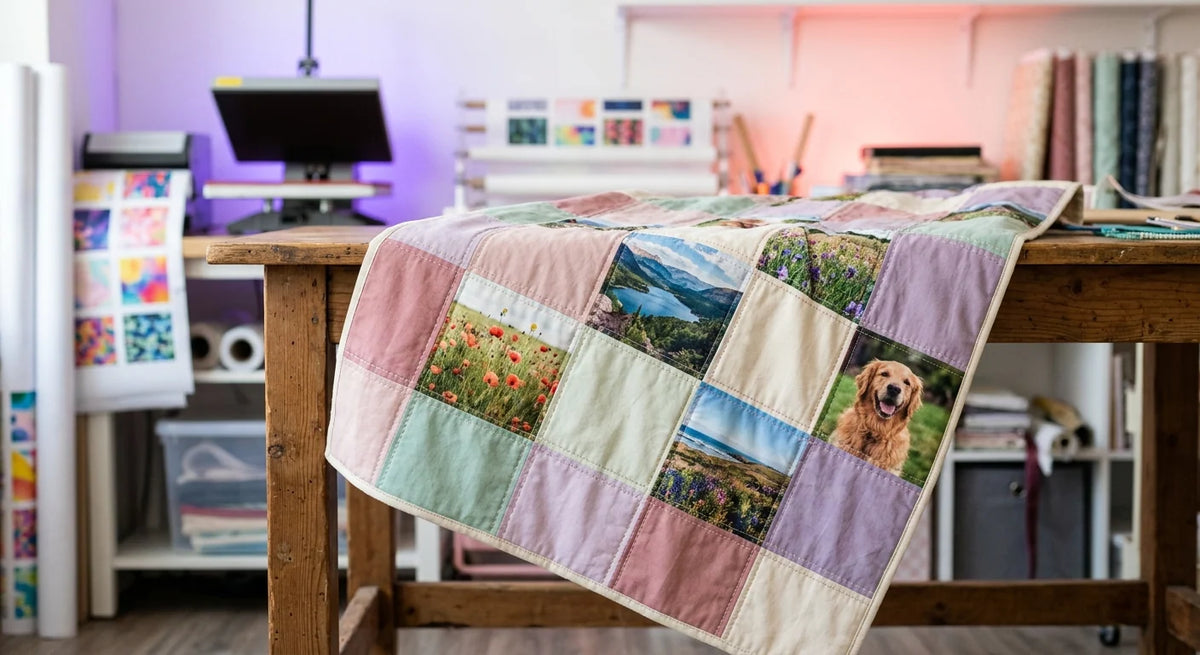
Upcycled shirts are a real product category on resale platforms, and the sellers who last treat flips like retail inventory. The economics work because the garment is cheap and the transfer is printed with no minimum: you can test a design on one shirt before committing a haul to it, something wholesale custom heat transfers with batch minimums never allowed. Our guides on scaling with DTF as an online seller and starting a shirt business with zero equipment cover the business side. And when a flip's fabric is too far gone to wear, it still has a future: worn favorites become blocks in a memory quilt.
Searching for custom heat transfers near me in North Jersey or the NYC metro? Transfers ordered before 3:00 PM ET on business days get same-day processing, local pickup at 495 Mola Blvd, Unit #8, Elmwood Park runs on a 4:00 PM ET cutoff, and rush service turns orders around in 1–3 hours when placed by 4:00 PM ET, with the fee shown at checkout. Shipping is free on qualifying orders, with carrier options shown at checkout.
Give the Thrift Find Its Second Life
Order your artwork as a custom transfer at exact size, or press a ready-made design straight from the collection. No minimums, no setup fees, no color limits.
Order Custom Transfers Shop Ready-to-Press DesignsFrequently Asked Questions
Can you put custom heat transfers on thrift store shirts?
Yes. DTF Jersey custom transfers press onto secondhand shirts the same way they press onto new blanks, and adhesion is strongest on the 50%+ cotton fabric most vintage tees are made of. Wash and fully dry the garment first without fabric softener, pre-press it flat, then apply at 290 to 310°F with a hot peel. For a shirt with no care tag, press one test transfer on a hidden spot before committing the design.
What type of custom heat transfer is best for upcycling shirts?
DTF transfers fit thrift flipping best because they print full color at any exact size with no minimum order, and they bond to the mixed fabrics a thrift haul contains. Cut vinyl handles only simple shapes and sits stiff on softened vintage fabric, while screen-printed plastisol transfers need batch quantities and fixed sheet formats to make sense. DTF Jersey prints one transfer or a full haul's worth for the same process, so order a single design and test your first flip.
Is there a minimum order for custom heat transfers?
No. DTF Jersey has no minimum order, so one custom transfer for a single thrift flip processes the same way as a wholesale-scale batch. Transfers print at the exact dimensions you order rather than a fixed 11x14 sheet, and a mixed haul of designs tiles onto one gang sheet up to 22 inches wide and 200 inches long, priced by length with no setup fees. Start with one test transfer, then scale the designs that sell.
Can I print over an existing design on a thrifted shirt?
Avoid it. An old print is a raised, often cracked surface, so a new transfer pressed on top gets uneven pressure and bonds poorly at the edges. Place the new design on clean fabric instead, work around existing graphics with layering techniques, or choose shirts with open print areas. Keep in mind that brand logos and licensed graphics stay protected even secondhand, so flips built for resale should carry your own artwork on plain garments.
Will a new transfer last on an old, worn shirt?
Yes, if the fabric itself is sound. DTF Jersey transfers are Intertek-tested for 100+ wash cycles with no major cracking, peeling, or color fading when applied correctly, and washed-soft cotton takes the bond well. Skip shirts with thin, threadbare panels where the fabric is the weak point, wash flips inside out in cold water, and air dry or tumble low. Your single test press and one wash will confirm the pairing before a batch.
Where can I order custom heat transfers near me without artwork of my own?
DTF Jersey prints custom heat transfers in Elmwood Park, NJ, with same-day processing for orders placed before 3:00 PM ET on business days and local pickup at 495 Mola Blvd, Unit #8 on a 4:00 PM ET cutoff. No artwork? The ready-to-press transfer collection offers finished designs you can apply straight to a thrift find. Shipping is free on qualifying orders for flippers outside the area, with carrier options shown at checkout.