Article: Photo-Quality Printing on Caps: Full-Color DTF Designs on Hats
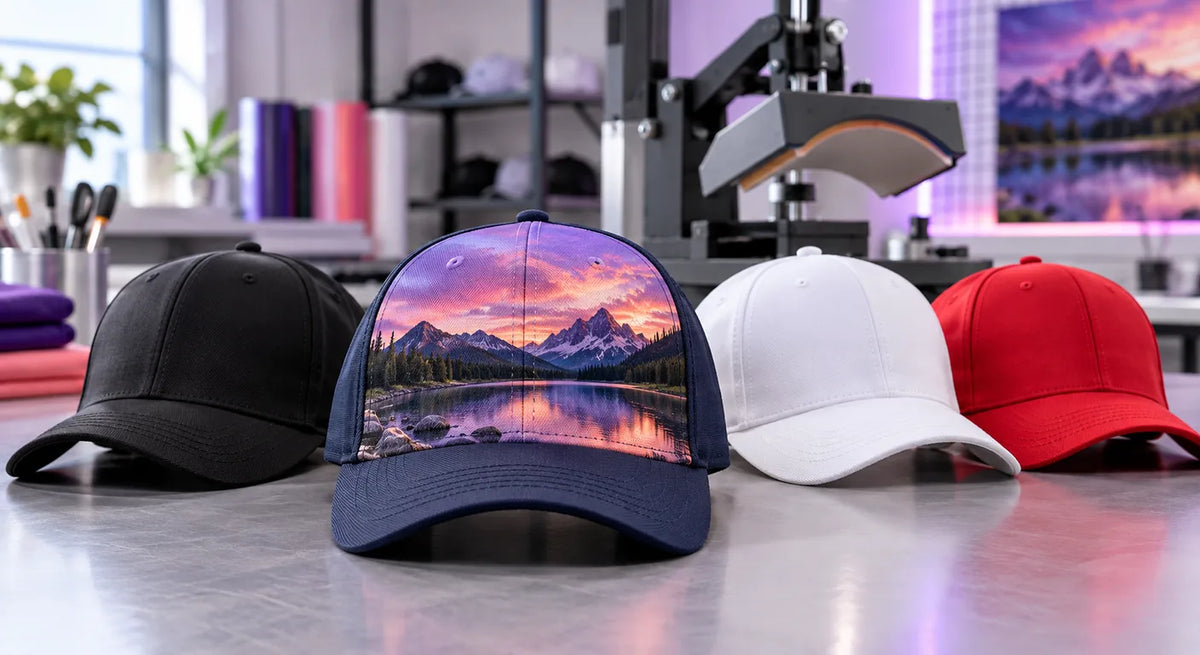
Photo-Quality Printing on Caps: Full-Color DTF Designs on Hats
Custom hat printing used to mean a choice between two compromises: embroidery that can't reproduce a gradient, or a vinyl patch that looks like a sticker. That's why photo-quality caps stood out so little until recently. DTF transfers changed the math: a full-color design with smooth gradients, fine linework, and even photographic detail now presses onto a cap front the same way it presses onto a t-shirt chest. This guide covers which cap styles print best, how to size artwork for the small front panel, and the pressing technique that handles the curve.
Why DTF Is the Photo-Quality Method for Hats
The front panel of a cap is a small, curved, often dark-colored canvas, and each of those properties eliminates at least one traditional decoration method. Here's how the options stack up when the goal is a full-color, detailed design:
Which Cap Styles Print Best
Sizing Artwork for a Cap Front
The single most common cap-printing mistake is sizing the design like a shirt print. A cap front offers a fraction of the space, and photo-quality detail only survives if the artwork is prepared for it:
Measure your actual blank before finalizing, since panel heights vary by style. Upload a transparent PNG at 300 DPI minimum, sized at the dimensions you'll press. At cap scale, thin strokes and small type turn muddy, so simplify anything finer than about a millimeter. Full placement guidance lives in our DTF transfer size guide.
Ordering is simple at this scale: a stack of identical cap-front logos goes through custom DTF transfers by size, and mixed designs tile onto a gang sheet, covered in the bulk section below.
Pressing Caps: Equipment and Technique
Caps are the one garment where equipment genuinely matters. A standard flat heat press wants a flat surface, and a cap refuses to be one. Two routes work:
🔥 Press Settings for Standard DTF Transfers
Bulk Custom Hats for Business and Promo
Branded caps are promotional-product royalty: one size fits most, nobody throws a good hat away, and the logo rides at eye level. Cap-front prints are also small, which makes bulk orders unusually efficient on a gang sheet. A sheet runs 22 inches wide and up to 200 inches long, and at 3 to 4.5 inches per design, a single sheet holds dozens of cap-front prints, mixed designs included. That's the production line behind wholesale custom hats for shops, promotional caps for events, and custom hats for business giveaways.
- One logo, many caps: order a stack through custom transfers by size.
- Mixed designs or sizes: tile everything in the DTF Gang Sheet Builder and pay by sheet length, with no setup fees or color limits. Our gang sheet guide covers the layout strategy.
- Caps plus shirts: teams usually want both; pair this guide with our custom team shirts guide to combine the order.
With no minimum order, a single test cap is the smart first step: press one, check the curve, then run the batch. Orders placed before 3:00 PM ET on business days get same-day processing, local pickup in Elmwood Park runs on a 4:00 PM ET cutoff, and rush service turns orders around in 1–3 hours when placed by 4:00 PM ET, with the fee shown at checkout.
Durability and Care
Care is easier than shirts: spot clean or hand wash in cold water, reshape, and air dry. Skip the machine dryer, which punishes the cap's structure more than the print.
Put a Photo-Quality Print on Your Next Cap
Order cap-sized transfers by exact dimensions, or tile a full batch of designs onto one gang sheet. No minimums, no setup fees, no color limits.
Order Transfers by Size Build a Gang SheetFrequently Asked Questions
Can you print photo-quality images on hats?
Yes. DTF Jersey transfers print full color with smooth gradients and photographic detail, and the white ink underbase keeps colors vivid on black and navy caps. Prepare the image as a transparent PNG at 300 DPI minimum, sized for the cap front at roughly 3 to 4.5 inches wide. Order a single test transfer first and press it on your exact blank to confirm the result before a batch.
What size should a design be for a cap front?
Plan for roughly 3 to 4.5 inches wide and about 2 inches tall, then measure your actual blank, since panel heights vary by cap style. Keep strokes and lettering bold, because detail finer than about a millimeter turns muddy at cap scale. DTF Jersey prints custom transfers by exact size, so order at the final press dimensions rather than scaling down a shirt file.
Do I need a special heat press for hats?
A cap press with a curved platen gives the most consistent results because it matches the panel's shape and delivers even pressure. For occasional caps, a flat press works if you support the panel from inside with a rolled towel or small pressing pillow and press the front panel only. Either way, press DTF Jersey transfers at 290 to 310°F with a hot peel and a brief re-press to seal the edges.
Is DTF better than embroidery for custom hats?
For full-color, gradient, or photographic designs, yes: thread cannot blend colors, so embroidery is limited to solid-color logos and text, while a DTF Jersey transfer reproduces the complete design in one press with no per-color charges. Embroidery still suits simple text looks where stitched texture is the point. If your artwork has shading, a photo, or more than a few colors, DTF is the method that reproduces it.
Is there a minimum order for custom hat transfers?
No. DTF Jersey has no minimum order, so one personalized cap transfer processes the same way as a 200-piece promotional run, and blank OTTO caps can ship in the same order as the transfers. Orders placed before 3:00 PM ET on business days get same-day processing, and local pickup at 495 Mola Blvd, Unit #8, Elmwood Park, NJ runs on a 4:00 PM ET cutoff. Press one test cap, then scale the same artwork to a full gang sheet.
How long does a DTF print last on a hat?
DTF Jersey transfers are Intertek-tested for 100+ wash cycles with no major cracking, peeling, or color fading when applied correctly, and caps get washed far less often than shirts, so the print operates well inside its tested limits. Spot clean or hand wash the cap in cold water, reshape it, and air dry. Skip the machine dryer, which stresses the cap's structure more than the print itself.