DTF vs Vinyl Transfers: Which Lasts Longer on Your Garments?
Vinyl transfers and DTF transfers are both heat-applied, but they are fundamentally different products with different strengths, different failure modes, and different use cases. Choosing the wrong one for a specific application is not just a quality issue. It affects how long the print survives, how it feels on the garment, and what designs are even possible.
This comparison covers the real differences between DTF and vinyl, where each wins, and which one is the better default for most decorators in 2026.
- What DTF and Vinyl Transfers Actually Are
- Wash Durability: How Each Holds Up Over Time
- Stretch and Feel on the Garment
- Detail and Color Range: Where DTF Pulls Ahead
- Application: Heat Press Requirements for Each
- Cost Comparison: Per-Transfer and Setup
- When Vinyl Still Makes Sense
- Frequently Asked Questions
- Full-color digital print, any image
- Soft hand feel on the garment
- Intertek-tested 100+ wash cycles
- No per-color charge or color limit
- No equipment needed beyond a press
- Cut from flat sheets or screen-printed
- Plastic-layer feel, especially on large prints
- Edge peeling common on stretchy fabrics
- One color per layer (craft vinyl)
- Requires a vinyl cutter ($200–$400+)
What DTF and Vinyl Transfers Actually Are
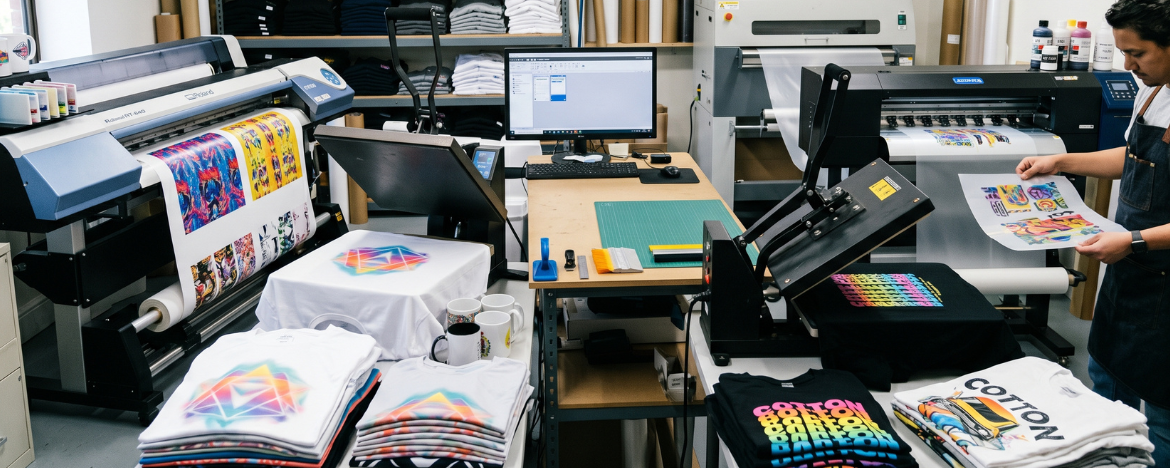
DTF (Direct to Film) transfers are printed using inkjet-style printing onto a polyester film. A white ink underbase is printed first, then CMYK color inks on top, then a hot-melt adhesive powder is applied and cured. The result is a multi-layer transfer that bonds to fabric when heat-pressed.
Vinyl transfers, also called HTV (heat transfer vinyl) or screen print transfers, work differently depending on the type. Craft vinyl (like Siser EasyWeed) is a single-color polyurethane sheet cut to shape and pressed onto fabric. Screen print transfers are pre-printed vinyl transfers produced using screen printing, stacked and shipped for pressing.
The key structural difference: DTF is printed at the pixel level and can reproduce any image, gradient, or photograph. Vinyl is either cut from flat sheets (one color per layer) or screen-printed (requires screens, limited colors per design). DTF produces a full-color printed image from a single digital file. Vinyl builds designs from physical layers.
Wash Durability: How Each Holds Up Over Time
DTF transfers at DTF Jersey are Intertek-tested for 100+ wash cycles with no major cracking, peeling, or color fading when applied at recommended settings and cared for with inside-out cold wash and low-heat drying. The adhesive layer bonds into the fabric surface, which is part of why DTF prints stretch with the garment rather than separating from it.
Craft vinyl on athletic polyester tends to peel at the edges after repeated washing, particularly on stretchy fabrics. The vinyl layer does not stretch as well as the fabric, which creates stress at the edges during wear and washing. Many decorators producing vinyl shirts for sports teams have experienced this failure mode — peeling corners and edges after a season of wear.
Screen print transfers (pre-printed vinyl) are more durable than craft vinyl but still follow the same physical limitation. A vinyl layer bonded to fabric stretches differently than the fabric itself. Over time, the mismatch can cause cracking and edge separation.
DTF reduces this failure mode because the adhesive integrates into the fabric structure rather than sitting on top of it as a separate layer. The print remains flexible through the same range of motion as the garment.
For a full breakdown of DTF transfer durability across wash cycles and fabric types, see DTF Jersey's DTF Transfer Durability guide.
Stretch and Feel on the Garment
DTF transfers have a soft hand feel after pressing. The ink layer is thin and the adhesive integrates into the fabric surface. On a properly pressed DTF transfer, the print area feels like the fabric itself with a slight texture rather than a separate layer sitting on top.
Vinyl transfers have a more pronounced feel on the garment. Craft vinyl feels like a plastic layer, and on stretchy athletic fabrics the difference is noticeable during wear. Thicker vinyl formulations on larger design areas can restrict the fabric's natural stretch.
Screen print transfers have a thicker feel than craft vinyl because of the ink layers involved in printing. On large back prints, the vinyl feel is apparent to the wearer.
For athletic garments, uniforms, and performance wear where the garment needs to move freely, the soft hand feel of DTF is a practical advantage. For promotional or event shirts where feel is less critical, the difference matters less.
Detail and Color Range: Where DTF Pulls Ahead
DTF printing is pixel-based and can reproduce any image at full color, including gradients, photographs, skin tones, and complex artwork with hundreds of color transitions. DTF has no per-color charge and effectively no design complexity limit at typical print sizes. A 20-color gradient prints at the same cost as a two-color graphic.
Craft vinyl is limited to one color per layer. Complex multi-color designs require cutting and pressing multiple layers of vinyl, which is time-intensive, prone to misalignment, and physically impossible for gradients or photographic images.
Screen print transfers can produce multiple colors but are limited by the screen count. A supplier charging per color means multi-color designs cost proportionally more. Gradients in screen printing require halftone simulation, which produces a different visual than a smooth digital gradient.
For any design that involves more than two to three solid colors, a logo with gradients, photographic artwork, or complex illustrated graphics, DTF is generally the more practical option between the two. Vinyl is not a viable alternative for this category of design.
The detail advantage extends to text. Small text and thin lines in DTF transfers are sharp at sizes where vinyl would need to be cut with precision equipment that may not hold fine detail reliably.
Application: Heat Press Requirements for Each
Both methods require a heat press. The settings differ.
🔥 DTF Jersey Press Specs
Craft vinyl typically applies at 305–320°F for 10–15 seconds with firm pressure, followed by a warm or hot peel depending on the vinyl type. Some vinyl requires immediate peeling while still hot; others require a warm peel after a brief cool-down.
The practical difference in application is the peel behavior. DTF peel type varies by supplier — DTF Jersey transfers are hot-peel, while some other DTF films are cold-peel. Always check the product specification before pressing your first batch.
Both methods work on the same heat press equipment. No specialty hardware is required for either, which means a decorator switching from vinyl to DTF does not need new equipment.
Cost Comparison: Per-Transfer and Setup
Craft vinyl cost is primarily material and cutting time. A roll of craft vinyl typically costs $1 to $3 per foot depending on type. A simple two-color design might use $0.50 to $1.50 in vinyl material — but a complex multi-layer design uses significantly more material and takes longer to weed and layer, adding labor cost.
DTF transfer cost depends on size and order format. For most standard sizes, DTF transfer cost is competitive with vinyl on a per-piece basis — without the cutting and weeding labor. Check current pricing on the Custom DTF Transfers by Size and DTF Gang Sheet Builder product pages.
For decorators who already own a vinyl cutter, the equipment cost is sunk. For decorators evaluating which method to invest in, DTF sourcing from an outside supplier removes the equipment cost entirely.
When Vinyl Still Makes Sense
DTF is the better default for most applications, but vinyl has legitimate use cases:
Outside these specific scenarios, DTF generally handles the job better. Full color, better stretch performance, softer feel, and no equipment investment are advantages that apply to the majority of custom apparel production.
For a side-by-side comparison of DTF against all major print methods including screen printing, DTG, sublimation, and vinyl, with verdicts on which use cases each one serves best, see DTF Jersey's T-Shirt Printing Methods guide.
Order Full-Color Transfers That Outlast Vinyl
Same-day ship from NJ before 3:00 PM ET. Intertek-tested 100+ wash cycles, no minimums, no setup fees.
Browse DTF Transfers → Build a Gang SheetFrequently Asked Questions
Which lasts longer — DTF or vinyl transfers?
DTF transfers generally last longer than craft vinyl on most apparel. DTF Jersey's transfers are Intertek-tested for 100+ wash cycles, with the adhesive integrating into the fabric surface rather than sitting on top as a separate layer. Craft vinyl on stretchy or athletic fabrics tends to peel at the edges after a season of wear, since the vinyl sheet doesn't stretch at the same rate as the fabric underneath. Pre-printed screen-print vinyl transfers are more durable than craft vinyl but follow the same underlying physical limitation.
Does DTF feel softer than vinyl on a shirt?
Yes. DTF transfers have a soft hand feel because the ink layer is thin and the adhesive integrates with the fabric surface, so the print area feels close to the fabric itself with a slight texture. Vinyl, especially craft vinyl on stretchy athletic fabrics, has a noticeable plastic-layer feel — and thicker vinyl on larger design areas can restrict natural fabric stretch. For athletic garments and uniforms, the soft hand of DTF is a practical advantage.
Can DTF print colors and details vinyl can't?
Yes. DTF is pixel-based and can reproduce gradients, photographs, skin tones, and complex multi-color artwork from a single digital file with no per-color charge. Craft vinyl is limited to one color per cut layer, which makes gradients and photographic images physically impossible. Screen-print vinyl can produce multiple colors but is limited by screen count and uses halftone simulation for gradients rather than smooth digital transitions. For any design beyond two or three solid colors, DTF is generally the more practical option.
Can I use my existing heat press for DTF if I currently press vinyl?
Yes. DTF uses the same heat press equipment as vinyl — no specialty hardware required. The settings differ: DTF Jersey's verified specs are 290–310°F using high pressure for 6 seconds or medium pressure for 8–15 seconds, followed by a hot peel for DTF Jersey transfers. Switching from vinyl to DTF requires no equipment investment beyond the heat press you already own.
When does vinyl still make sense over DTF?
Vinyl is a reasonable choice for: single-color designs in large quantities (bulk promotional shirts), very simple two-color text and clean-line logos, specialty surface finishes only available in vinyl (reflective, holographic, flock), and very large simple back prints where vinyl material cost can sometimes undercut DTF. For everything else — full-color designs, gradients, photographic artwork, athletic uniforms, small-batch custom work — DTF is generally the more flexible and cost-efficient default.