DTF Transfer Sizes: Right Fit for Every Garment
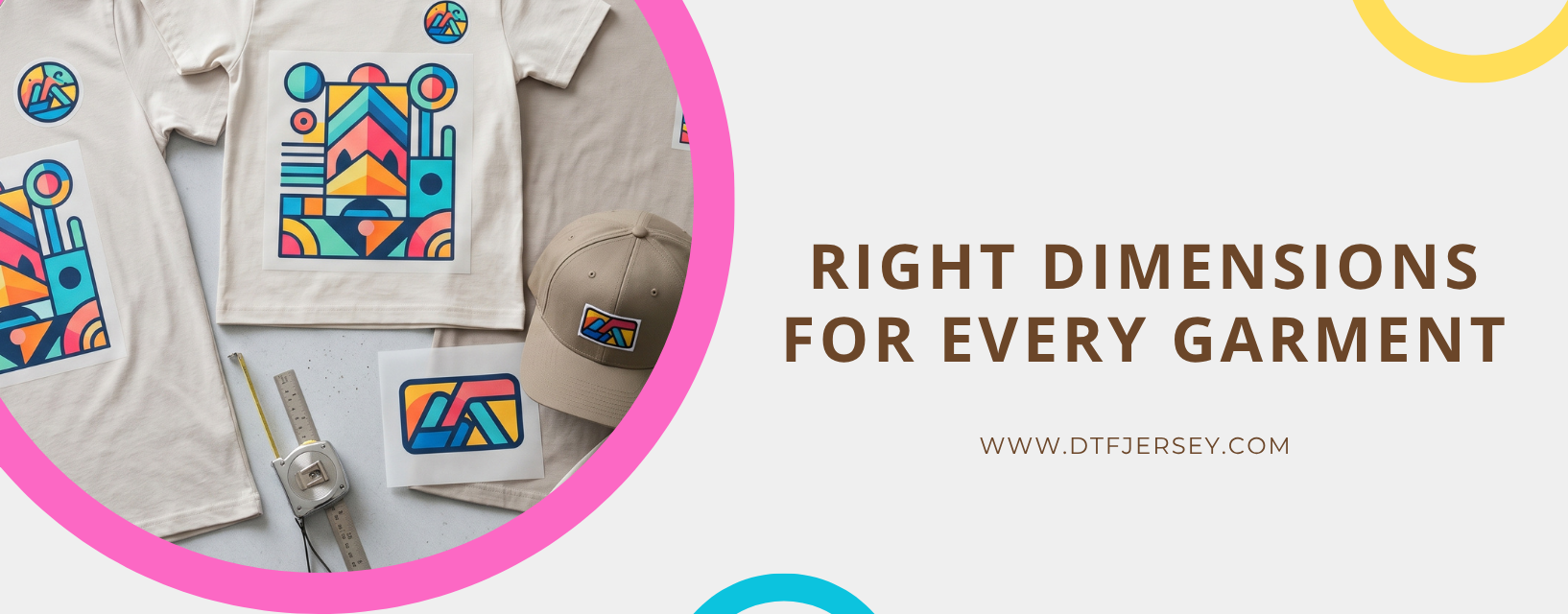
Getting the transfer size right before you order avoids a specific kind of waste: a correctly printed design that is the wrong size for the garment it goes on. A full-front print size for an adult medium looks oversized on a youth small and undersized on a 2XL. A left-chest print that works on a T-shirt is too large for a hat front.
Transfer size is also the primary cost lever in per-unit ordering. Larger transfers cost more. Ordering a transfer at the correct size rather than guessing large saves money across every order.
- Why Transfer Size Matters Before You Order
- Left Chest Prints: Standard Size Range
- Full Front and Full Back: Adult and Youth Sizing
- Sleeve and Pocket Prints: Smaller Format Rules
- Hat and Cap Sizing
- How Size Affects Cost Per Transfer
- Ordering DTF Transfers by Size at DTF Jersey
- Frequently Asked Questions
Why Transfer Size Matters Before You Order
DTF transfer size affects three things: how the design looks on the garment, how much the transfer costs, and whether the design fits within the printable area of the specific garment you are using.
A design at the wrong size looks off even if the print quality is perfect. An oversized left-chest logo that extends past the armhole seam is a production error. An undersized full-front design centered on a large garment leaves an awkward amount of empty fabric above and below.
Sizing the garment requires knowing the standard print areas for each garment type and measuring the specific blanks you are using, since printable areas vary between manufacturers and styles. Standard reference dimensions are starting points. Measuring the actual garment before finalizing design dimensions is the most reliable step.
For a comprehensive reference of size charts across all garment types and how to measure print areas on specific blanks before ordering, see DTF Jersey's DTF Transfer Sizes guide.
Left Chest Prints: Standard Size Range
The left chest print is the most common application in custom apparel and the most consistent in terms of acceptable size range.
Full Front and Full Back: Adult and Youth Sizing
Full front and full back prints are the largest garment print areas and have the most variation between garment sizes.
| Garment Size | Full Front Width | Full Back Width |
|---|---|---|
| Adult Sizes | ||
| Small – Medium | 10–11" | 11–12" |
| Large – XL | 11–12" | 12–13" |
| 2XL & Above | 12–14" | 13–15" |
| Youth & Toddler Sizes | ||
| Youth (Scale 70–80%) | 8–10" | 9–11" |
| Toddler (2T+) | 6–8" max | 6–8" max |
The height of a full-front design is typically 12 to 14 inches for a vertically oriented design. Wider designs with less height are common for landscape-oriented artwork. Full back height can extend from the collar area down to the tail, typically 14 to 16 inches on adult shirts.
Youth full front and back: scale down proportionally. A youth medium has roughly 70 to 80 percent of the printable area of an adult small. Toddler garments have significantly smaller print areas — design proportionally and verify against the actual garment dimensions.
For decorators producing prints across multiple sizes of the same design, building size-specific art files for each garment size range rather than scaling a single file ensures the design looks correctly proportioned on every size.
Sleeve and Pocket Prints: Smaller Format Rules
Sleeve and pocket prints use smaller transfer sizes and have constraints that full-front prints do not.
Sleeve and pocket prints are common as secondary placements alongside a primary left-chest or full-front design. They add design value without significant material cost, since small transfers are among the most economical DTF sizes.
Hat and Cap Sizing
Hat prints have specific dimensional constraints based on panel shape and crown height.
For detailed guidance on pressing DTF on caps and how to include hat front panels in a gang sheet layout alongside larger garment designs, see DTF Jersey's DTF Gang Sheets guide.
How Size Affects Cost Per Transfer
At DTF Jersey, custom transfers by size are priced based on the dimensions of the design. Larger transfers cost more because they occupy more of the production output.
The gang sheet format changes this dynamic. Gang sheets are priced per section, so packing multiple smaller designs into a single section distributes the section cost across multiple transfers — bringing the per-transfer cost down significantly.
For decorators ordering consistent small-format designs (left chest, hat front, sleeve prints), gang sheets are significantly more cost-efficient than individual transfers by size. The cost difference between ordering individually vs on a sheet narrows when each design fills most of a section on its own. Check current pricing on the Custom DTF Transfers by Size and DTF Gang Sheet Builder product pages.
- Large single designs (full back, oversized graphics)
- One-off custom pieces or replacements
- Test orders before committing to bulk
- Specific dimension requirements
- Three or more smaller designs at once
- Repeat orders of the same artwork
- Left chest, hat front, sleeve, pocket prints
- Mixed-size production batches
Ordering DTF Transfers by Size at DTF Jersey
DTF Jersey offers both ordering formats: individual transfers by size and gang sheets.
For individual transfers by size, go to the Custom DTF Transfers by Size product page. Upload your design file, set the width and height in inches, select the quantity, and order. The transfer prints at exactly the dimensions you specify.
For gang sheet orders combining multiple designs at multiple sizes, use the DTF Gang Sheet Builder to arrange designs on the 22-inch wide sheet, or upload a pre-arranged layout at the Upload DTF Gang Sheets page.
Order at the Exact Size You Need
Same-day ship from NJ, Intertek-tested 100+ wash cycles, no minimums, no setup fees.
Order by Size → Build a Gang SheetFrequently Asked Questions
What size should a left chest DTF transfer be?
Standard adult left chest prints are 3–4 inches wide for logos and branded designs. Text-heavy designs can go up to 4–5 inches wide, though at 5 inches you're approaching center-chest territory. Youth and child sizing scales down to 2.5–3.5 inches, and hat front panels stay at 2–3 inches wide. Always measure the specific blank — the design should not exceed 70–80% of the distance from the button placket to the armhole seam.
What size should a full-front DTF transfer be?
Full-front print width scales with garment size. Adult small to medium: 10–11 inches wide. Large to XL: 11–12 inches wide. 2XL and above: 12–14 inches wide. Vertical height typically runs 12–14 inches for portrait-oriented designs. Youth full-front designs scale to about 70–80% of adult small dimensions, around 8–10 inches wide. For multi-size print runs, build size-specific art files rather than scaling one file across sizes.
What's the maximum DTF transfer size for a hat or cap?
Structured 6-panel caps have a maximum printable area of about 2–2.5 inches tall and up to 5 inches wide. The vertical constraint is the height between the brim basting line and the top of the front panel. Unstructured dad hats have similar width but slightly less vertical room. Beanies allow 3–4 inches wide at the front center, but stretchable fabric won't flex with rigid designs — and 100% acrylic beanies are heat-sensitive, so test on a single piece before pressing a batch.
Is it cheaper to order DTF transfers by size or on a gang sheet?
It depends on the design size. For large single designs (full back, oversized graphics), ordering individually by size is usually the simpler route. For multiple small designs (left chest, hat front, sleeve, pocket), gang sheets are significantly more cost-efficient since multiple designs share one section cost. The general rule: 3+ smaller designs at once → gang sheet. Single large design or one-off custom → order by size.
How do I know if my design will fit on the specific garment I'm using?
Standard reference sizes are starting points, but printable areas vary between manufacturers and styles. Place a ruler or tape measure across the actual blank to find the available print area — from button placket to armhole for chest prints, or measure sleeve circumference and pocket dimensions for secondary placements. The design should generally stay within 70–80% of the available width to leave visual breathing room. See DTF Jersey's DTF Transfer Sizes guide for full reference charts.