T-Shirt Printing Cost: DTF vs Screen Printing vs Sublimation
For any custom apparel business, understanding the true cost of production is the fundamental driver of profitability. Businesses must ask, "Which printing method provides the best Return on Investment (ROI) across varied order sizes and designs?"
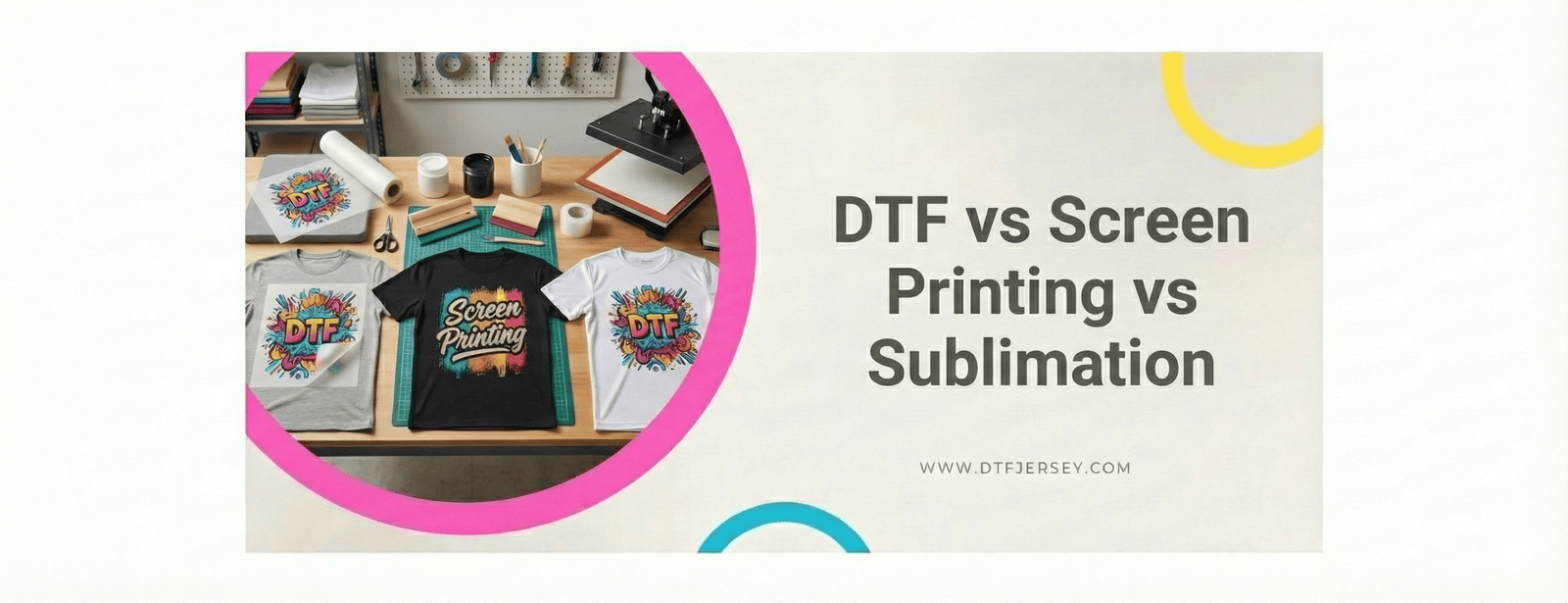
In 2025, three primary technologies dominate the market, each with a unique cost structure: Direct-to-Film (DTF) printing, Screen Printing, and Sublimation. The difference in operational expenditure (OpEx), setup time, and material cost means the most cost-effective solution depends entirely on your business model.
This comprehensive financial and technical guide provides a clear breakdown of the costs associated with each method, helping entrepreneurs and designers make data-driven decisions on how much to print a t-shirt while maximizing their margins.
How Much Does T-Shirt Printing Cost in 2025?
Two main factors determine the cost to produce a custom t-shirt: Fixed Costs (initial investment, equipment, and training) and Variable Costs (consumables, labor, and utilities per piece).
Key Cost Variables by Method:
-
Screen Printing: Dominated by high Fixed Setup Costs (screens, registration, cleanup labor). Variable costs are very low for large batches.
-
Sublimation: Characterized by low initial Equipment Costs but limited by high Consumable Costs (paper, specialized polyester blanks) and fabric restrictions.
-
DTF Printing: Offers a balanced approach with moderate Equipment Investment and predictable Variable Costs that remain consistent across different batch sizes.
The final price per unit must cover the cost of the blank garment, the variable printing cost, the labor time, and an allocated portion of the fixed costs. The answer to "how much to print a t-shirt" ranges from as low as 1.50 (for 1,000+ unit screen printing) to 10.00 (for complex, small-batch digital prints).
DTF Printing Costs Breakdown
DTF printing excels in its cost consistency, avoiding the large non-recurring fees of screen printing and the fabric limitations of sublimation.
Fixed Costs (If Buying Equipment)
The investment for a complete DTF setup (Printer, Shaker/Curing Unit, Heat Press) ranges from 4,000 (Entry-level Desktop DTF) to over 30,000 (Industrial Roll-to-Roll DTF).
Variable Costs (Consumables per Transfer)
Four main consumables determine the printing cost per transfer:
-
DTF Ink (CMYK + White): White ink is the most expensive component due to the necessary titanium dioxide pigment. High white ink coverage drives the price up.
-
PET Film: The transfer medium, costed by the square foot or meter.
-
Thermoplastic Powder (TPU): The adhesive layer.
-
Labor (Application): Time spent heat-pressing the finished transfer onto the garment. This step is fast (15-20 seconds), keeping application labor costs low, especially when following our application best practices.
-
For a standard 12" x 12" full-color design, the variable cost for a high-quality DTF transfer typically falls between 3.50 and 5.50. This cost remains relatively stable whether you print one piece or fifty, which is the cornerstone of the DTF advantage for small batches.
Screen Printing vs DTF Cost Comparison
The fundamental difference between these two methods is where the cost bottleneck occurs: Screen Printing hits the cost bottleneck at setup; DTF hits the bottleneck at ink/consumable usage.
| Cost Factor | Screen Printing (4 Colors) | DTF Printing (Full Color) | Financial Advantage |
|---|---|---|---|
| Setup Cost (Fixed) | High (Labor to create screens, register colors, and clean up) | Zero (Digital File) | DTF (Eliminates non-recurring setup fees) |
| Consumable Cost (Ink) | Very Low (Inks are cheap in bulk) | Moderate to High (White ink is expensive) | Screen Printing |
| Minimum Order Viability | 50 - 100 pieces (Due to setup time/cost) | 1 Piece (Ideal for Print-on-Demand) | DTF |
| Color Complexity Cost | Scales exponentially (Each color is a new screen, increasing setup cost) | Fixed (Printing 1 color costs the same as 10) | DTF |
| ROI Break-Even Point | Reached quickly only after 150-200 pieces | Reached quickly at 1 piece | DTF for most modern apparel businesses |
The DTF financial advantage is realized when complexity and volume are factored:
-
Low Volume Orders (1-50 pieces): Screen printing is cost-prohibitive. A four-color screen print setup might cost $100 in labor/materials, resulting in a $5.00 cost per piece just for setup on a 20-piece order. DTF has zero setup cost, making it drastically cheaper.
-
High-Complexity Designs (Full-Color/Photo-Realistic): DTF's fixed digital cost easily beats the screen printing need for 6+ color separation and screen fees, which would render the order too expensive for the customer.
Screen printing is only demonstrably cheaper and better than dtf when the order is high volume (200+ pieces) AND low complexity (1 or 2 colors). For the dynamic, small-batch, high-design market, DTF is the clear financial winner.
Sublimation vs DTF: Price & Quality Analysis
Sublimation is another popular digital method, but its cost structure imposes severe limitations on business scalability.
Cost & Limitations:
-
Fabric Restriction: Sublimation only works on 100% white or light-colored Polyester (or specialized blanks). DTF works on literally any fabric and color.
-
Variable Cost: While the ink is inexpensive, the cost of the required polyester blank garments can be higher than standard cotton t-shirts, and specialized sublimation paper adds to the expense.
-
Durability vs. Quality: Sublimation dyes the fabric fibers, achieving a zero hand-feel (the best quality in terms of touch). DTF creates a thin adhesive layer that offers far superior durability and wash fastness on a wider range of materials. DTF's superior durability is proven by our 50+ wash tests.
Sublimation is often cheaper for simple, light-colored polyester jobs. However, its restrictive nature (no cotton, no dark colors) prevents it from being a scalable business solution. DTF offers significantly better market versatility for a marginal increase in unit cost, making DTF better than sublimation.
Cost Calculator by Quantity: Finding Your Method's Sweet Spot
Finding the optimal quantity threshold is the key to maximizing profits with each technology. Use this analysis to identify the "sweet spot" where each technology provides the best value.
| Scenario | Quantity | Design Complexity | Best Cost-Effective Method | Rationale |
|---|---|---|---|---|
| Print-on-Demand | 1 - 10 pieces | High (Photo/Full-Color) | DTF | Zero setup cost; fixed digital cost ensures immediate ROI. |
| Corporate Events | 50 - 150 pieces | Moderate (Logos, 4-6 colors) | DTF | Setup costs for 4-6 color screens would make screen printing too expensive per unit. |
| Mass Uniforms | 250 - 1000+ pieces | Low (1-2 Spot Colors) | Screen Printing | Low variable ink cost dominates the calculation; setup cost is negligible when spread over many units. |
| Athletic Wear | Any | High Visibility (Polyester) | DTF | DTF's TPU adhesion works on poly blends, nylon, and specialty sportswear that other methods struggle with. |
Which Method is Most Cost-Effective?
The financial analysis leads to one clear conclusion: DTF is the most cost-effective solution for the modern apparel business.
While high-volume, single-color screen printing offers the lowest possible cost per unit, this represents a decreasing share of the market. The majority of today's custom orders require versatility, low minimums, and full-color graphics—areas where DTF's cost structure consistently outperforms.
-
DTF: Provides the highest gross margin potential for the typical order size (under 100 pieces), minimizes material waste, and offers the fastest way to recover equipment investment.
-
Business Model Alignment: By utilizing a DTF transfer service like DTF Jersey, businesses eliminate the entire fixed cost associated with purchasing, maintaining, and staffing DTF equipment. They shift all risk to the supplier, focusing only on the profitable, low-labor application phase. Eliminate the fixed cost risk by ordering your transfers from us.
Choosing the right printing technology is a decision that dictates your brand’s profitability and scalability. While sublimation offers zero hand-feel on limited fabrics, and screen printing remains unbeatable for 1,000+ single-color runs, DTF secures the best profit potential for businesses operating in the high-demand, low-volume custom apparel space.
DTF offers low setup friction, high design versatility, and predictable unit costs across nearly any fabric and order size. This makes DTF the optimal investment for maximizing profitability in the high-demand, low-volume custom apparel space.
Ready to calculate your profits using the most cost-effective solution? Upload your full-color design to DTF Jersey and get an immediate quote on transfers that require zero setup fees.